Because high-temperature, high-velocity water and steam flow through nuclear power plant piping, flow-accelerated corrosion and erosion can reduce pipe wall thickness and cause piping damage. For this reason, pipe wall thinning management is required in accordance with standards established by the Japan Society of Mechanical Engineers. Approximately 20,000 piping locations per plant are subject to management, and several hundred thickness measurement points are required for each location. This enormous inspection workload raises concerns about the prolonged duration of periodic inspections.
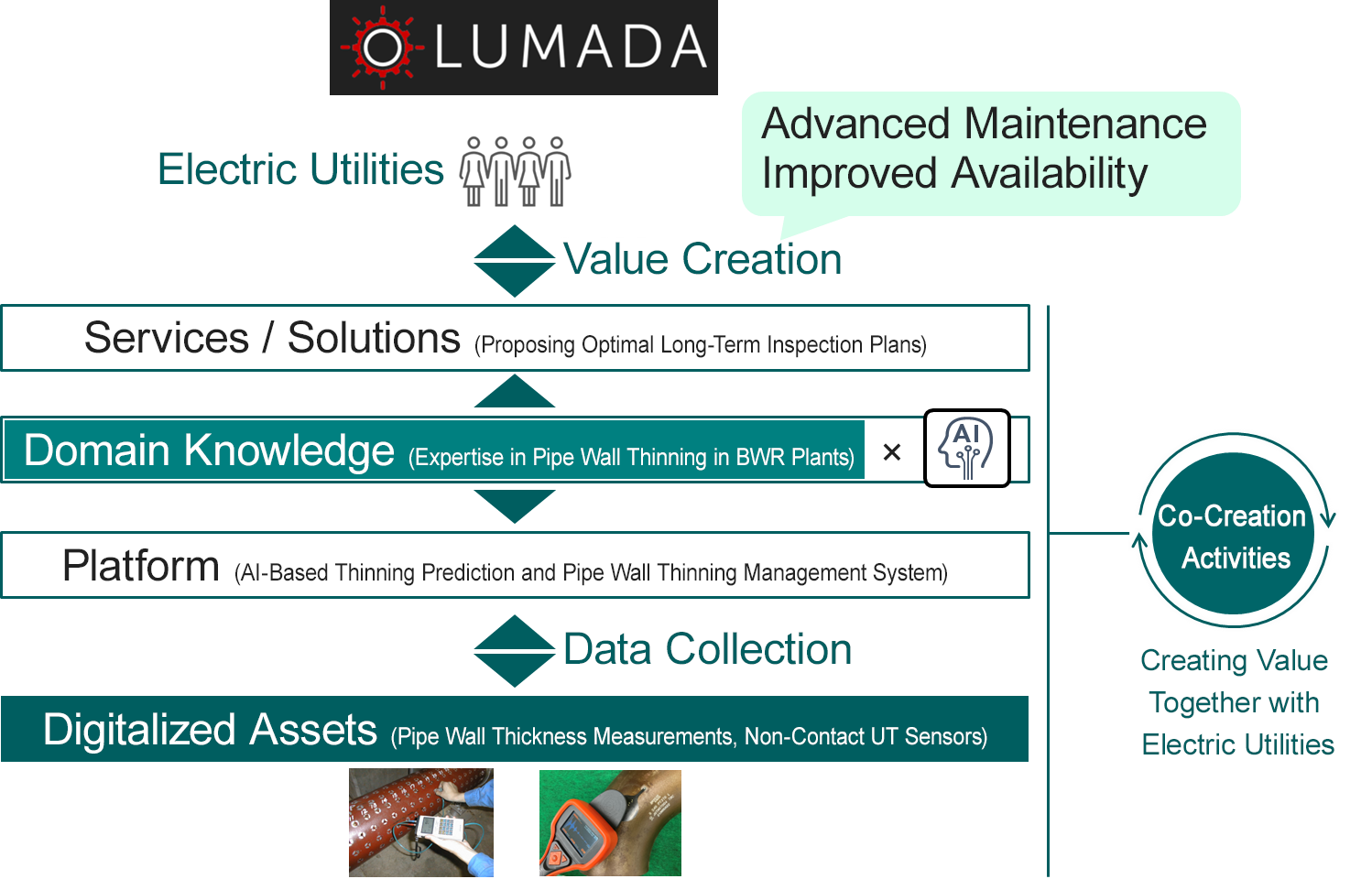
As part of Lumada promoted by Hitachi, we have developed a new pipe wall thinning management solution that combines AI-based thinning risk prediction and non-contact UT* sensors, contributing to shorter periodic inspections and improved plant availability and safety.
An AI-based thinning prediction model is developed using historical pipe thickness measurement data and fluid information obtained from instruments such as process computer data.
The model rapidly identifies and classifies high-risk locations among a large number of measurement points, determines inspection priorities, and proposes rational inspection plans.
Non-contact UT sensors jointly developed with the University of Bristol enable pipe wall thickness measurements to be completed in a shorter time compared with conventional methods.
Once the sensors are installed, removal and reinstallation of insulation are no longer required, and the use of extension tools facilitates measurements at elevated locations, contributing to reduced measurement time and radiation exposure in subsequent inspections. This enables efficient inspections that support shorter periodic outages.