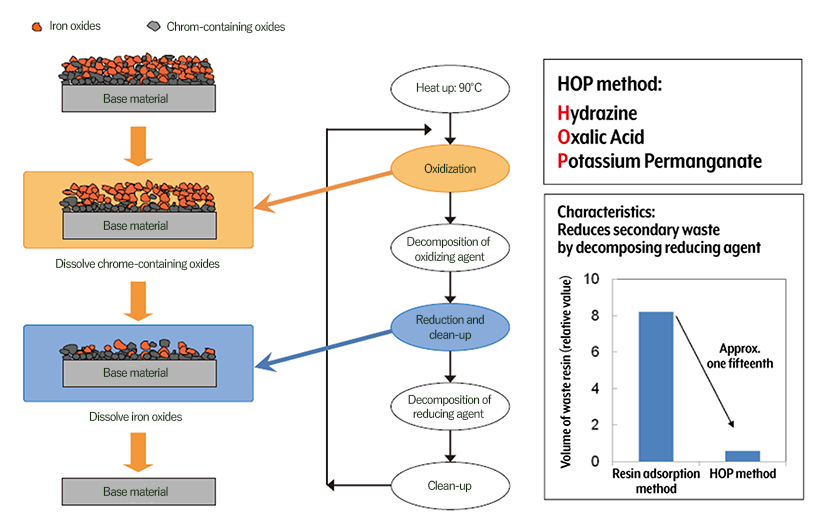
During periodic inspections and in-service work at nuclear power plants, removal of oxide films containing radioactive nuclides such as Co-60 from the inner surfaces of reactor components and piping is effective in reducing worker radiation exposure. The HOP chemical decontamination method (Hydrazine Oxalic Acid Potassium Permanganate) developed by us were the first domestically developed dilute redox chemical decontamination method applied to an advanced thermal reactor. The HOP method has been applied more than 90 times in Japan and overseas, significantly reducing radiation exposure levels at the applied power plants.
In the HOP method, oxide films on the inner surfaces of equipment and piping—the primary source of radiation exposure—are dissolved and removed through repeated oxidation-reduction processes. Because the decontamination agents are decomposed after use, the volume of secondary waste is reduced to approximately one-fifteenth of that generated by conventional resin adsorption methods.